
 400-086-9230


 联系我们


04
2026
-
11
Industrial Factory Moisture & Dust Control: How Top Clients Choose Dawang Ventilation
所属分类:
日期:
2026-11-04 10:28:17.699
Industrial plants and warehouses are most vulnerable to two problems: moisture causing condensation and equipment corrosion, and airborne machining dust. Small fans can’t move air effectively in large spaces, while dehumidifying with air conditioners consumes too much energy. Using low-speed, large-diameter industrial fans to create continuous air circulation is a common approach that balances moisture control and dust removal.
Three Real-World Pain Points of Industrial Space
Moisture and condensation cause damage to equipment and materials: In steel‑structure factories with large diurnal temperature variations and in warehouses located in high‑humidity regions, condensation readily forms on walls and floors, and moist air tends to accumulate at lower levels, leading to corrosion and moisture damage to equipment and materials (the same principles apply to warehouse moisture control and dehumidification).
Dust flying everywhere, and the pressure on cleanliness and occupational health: Workshops for machining, rubber and plastics processing, powder handling, and feed production continuously generate dust, posing significant challenges to dust control; excessively high air velocities can resuspend settled dust, leading to secondary dust generation.
Operating Costs and Noise Concerns: The renovation project has limited power distribution capacity, and the combined power of dozens of small fans would result in high wiring costs; the workshop requires low noise levels, and traditional high-speed fans frequently generate complaints.
Four factors to consider when selecting a model
Check the airflow pattern: Prioritize HVLS fans with high airflow and low rotational speed; their conical airflow spirals close to the floor to create overall circulation, rather than delivering a high‑velocity direct blast.
Check the diameter and airflow: The larger the diameter, the wider the coverage per unit. The W.Fans Smart Wind series from Dawang Ventilation features diameters of 3.6–8.5 meters and airflow rates of 10,800–21,800 m³/min.
Check the power and noise levels: Rated power 0.4–1.5 kW; flagship-series motors have a nominal noise level of ≤38 dB, making them suitable for quiet workshops.
Check the installation type: Choose a ceiling fan if you have a suspended ceiling; for spaces without a ceiling or converted warehouses, opt for the DW.Fans Premium Air vertical model (no installation required, energy consumption ≤0.8 kWh); use the DM.Fans Comfort Air portable unit for localized air supplementation (suitable for 300–600㎡, airflow range ≥25 meters).
Practical Implementation of DaWang Ventilation in Manufacturing Enterprises
Dawang Industrial Ventilation Large Fans have been installed in the workshops and warehouses of numerous manufacturing enterprises for ventilation and air circulation, as well as to assist with dehumidification and dust suppression.
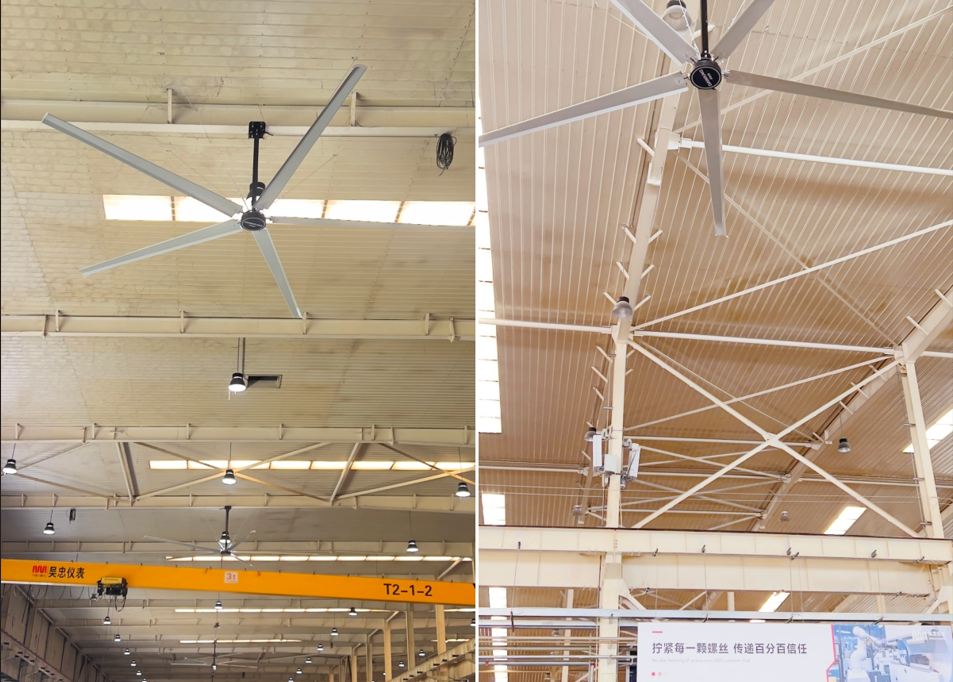
Jiangling Motors: 85 units + inspection and maintenance
Wuzhong Instrument: 60 units+
Anhui Saide Qirui: 22 units+
Shandong Rifare: 6 units + 38 units under maintenance
Hengli Hydraulics, Henan Oaks, Lianyungang Jereh, Jiangsu Benyou, Wuxi Baifa, Jiangyin Hongyuan, Anhui Huayu Each of them has deployments on the order of dozens of units.
These companies operate across industries including automotive, hydraulics, instrumentation, and equipment manufacturing. Their factories and warehouses commonly suffer from dampness, condensation, and machining dust. Dawang Ventilation addresses these issues with high‑volume, low‑speed fans for whole‑area air circulation, combined with dehumidification and dust removal systems.
Ventilation Management Recommendations
Operating Mode: It employs a “low-speed continuous operation + intermittent boost” strategy: during the plum rain season or periods of high humidity, it runs at low speed continuously throughout the day; during the dry autumn and winter months, circulation is maintained for several hours each day.
Installation highlights: Ceiling fans are recommended to be installed above main aisles, with a minimum clear height of 4.5 meters from the floor, and sufficient clearance between the fan blades and the tops of shelves or equipment.
Safety Reminder: In areas with high humidity, regularly inspect the sealing of lifting points and electrical junction boxes to prevent condensation from entering; do not establish permanent work stations beneath lifted loads, and strictly prohibit stacking excessively tall pallets within the fan blade area.
Good factory ventilation isn’t about cranking the fans to full blast; it’s about creating a quiet, steady airflow throughout the space—removing moisture and keeping dust under control.
Recommended News

-
Phone/Whatsapp:+86 189 215 00189
E-mail:yang@dawangfanschina.comNo.22,Yanjin Road,Huishan district,Wuxi,China
 sales@dawangfanschina.com
Copyright © 2020 Jiangsu Dawang Ventilation Machinery Co., Ltd.
Copyright © 2020 Jiangsu Dawang Ventilation Machinery Co., Ltd. | Powered by www.300.cn | Manager